On average, businesses suffer 14 hours of downtime every year. Businesses cannot always determine why this downtime occurs, but they can do more to proactively mitigate the negative impacts, particularly in terms of power quality.
 Why Standard Surge Protection is Insufficient
Jeff Edwards, CEO and Founder | Energy Control Systems
Here Jeff Edwards, CEO and founder of surge protection specialist Energy Control Systems explores why businesses can implement more sensitive power protection.
Power quality issues can occur for a variety of reasons — from faulty wiring to power line damage caused by extreme weather. While businesses cannot control when and where these events occur, they can mitigate the consequential damage.
Are you protected?
Equipment manufacturers and systems integrators may communicate to clients that the systems they install are designed for the harshest of industrial environments At the same time they may state that surge protection devices (SPDs) should be fitted and that the operating environment is the responsibility of the user in the fine print.
Businesses may know to install SPDs to protect their infrastructure from serious power outages. However, traditional SPDs are often only triggered by large changes in voltage and clamping only occurs at points high above or far below the sine wave. The dangers of regular power fluctuations may therefore still go unnoticed, but they can still cause disruption and long term damage.
Protecting the operating environment
Short voltage spikes are often ignored as they make little impact on production machinery. However, they can cause sensitive microprocessor-based systems, such as PLCs, to start prematurely by confusing the software.
These surges are known as transients — a short duration rise in voltage and current on an electrical circuit. Transients have high energy, with magnitudes in the thousands of volts, and short duration with rise times in the 1-10 microsecond range. Since they are sub-cycle events, they should not be confused with longer duration events such as swells or temporary over voltages. While these surges are short, transients can disrupt, damage or destroy electrical and electronic equipment in an instant.
Lightning protection
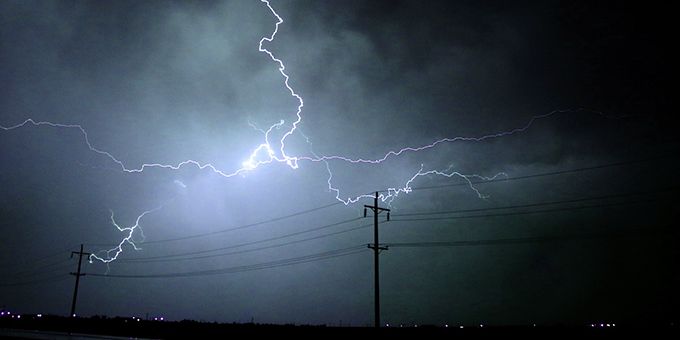
Lightning strikes and utility company grid switching are the major external sources of transients. The ground surge from nearby lightning strikes can damage electrical systems by entering unprotected circuits through the system ground. Cloud-to-cloud lightning discharges can induce electrical field intensities in the hundreds to thousands of volts per meter. If this type of transient appears across an unprotected power line, such as a telephone, data, or coaxial line, the result can destroy the system.
Cascade protection
Business owners have a responsibility to protect infrastructure from all types of power quality issues. While smaller and shorter voltage spikes or sags may not cause downtime, prolonged disruption can cause more damage than one power outage. Installing traditional surge protection equipment is no longer enough to protect infrastructure and business owners must find devices that can eliminate spikes that occur closer to the sine wave.
Facilities managers can also consider cascade protection, which involves installing SPDs at multiple locations, such as the main distribution board and distribution panel to effectively eliminate surges and reduce any residual transients that remain. This level of protection can increase uptime in even the most severe conditions.
14 hours in one year may not seem a significant amount of time. However, those hours can cost a business its profits and its reputation. Instead of believing that infrastructure will operate no matter the environment, businesses owners must be proactive and understand how to effectively mitigate the dangers of power fluctuations.
The content & opinions in this article are the author’s and do not necessarily represent the views of ManufacturingTomorrow
Featured Product