
Harvest CROO Robotics Develops Strawberry Picker, the Latest Solution in Agricultural Robotics
Harvest CROO Robotics is developing and beginning to test an automated strawberry picker which will save strawberry growers time and money and revolutionize the way strawberries are harvested.
Tampa, FL April 14, 2015
Harvest CROO Robotics is developing and beginning to test the latest technology for agricultural robotics -- an automated strawberry picker. The farming industry, nationwide, has felt the pain and unreliability of human labor. Over $750 million per year is spent in the U.S. picking strawberries alone.
Gary Wishnatzki, Co-Founder of Harvest CROO and owner of Wish Farms, sees first hand, as a member of the agricultural industry, the imminent need for an automated system for harvesting strawberries.
"I charged our engineers with the task of creating a 'picker' that does not require a grower to radically change the way they currently grow," said Wishnatzki. "That is the major reason other robotic harvesters have not yet been commercialized."
Harvest CROO machines will pick on traditional strawberry beds. Chief Technical Officer and Co-Founder, Bob Pitzer, took to the fields to study and observe the way human pickers harvest strawberries. With that information, he began outlining and conceptualizing the first prototype, which mimics the ways humans currently pick.
"With robotic manipulation, our biggest challenge is minimizing time," said Pitzer. "Based on our observations, our goal was to develop robots to pick as many berries as possible while utilizing conservation of motion."
In Phase I, $1 million was raised through qualified investors, including seven from the strawberry industry. In Phase II, Harvest CROO is seeking to raise $1.5 million to build the next version, the Alpha unit, which will be the predecessor to a production model. The Alpha will not only pick, but also place the berries into consumer packs.
Harvest CROO has a utility and a provisional patent filed.
To learn more about Harvest CROO, including current career opportunities for experienced engineers, contact info(at)harvestcroo(dot)com.
About Harvest CROO:
Harvest CROO began in 2012 on Gary Wishnatzki's vision of creating a solution to the dwindling labor force in agriculture. With the expertise of Chief Technical Officer, Bob Pitzer, they began developing the first Harvest CROO (Computerized Robotic Optimized Obtainer) machines. In Phase I, $1 million was raised through qualified investors. Seven of these investors are members of the strawberry industry, including Sweet Life Farms, Sam Astin III, California Giant, Inc., Main Street Produce, Inc., Sweet Darling Sales, Inc. Innovative Produce Inc., and DG Berry, Inc. In Phase II, Harvest CROO is seeking to raise $1.5 million to build the next version, the Alpha unit, which will be the predecessor to a production model. To learn more about Harvest CROO, including current career opportunities for experienced engineers, contact info(at)harvestcroo(dot)com.
Featured Product
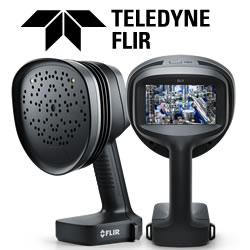
FLIR Si1-LD - Industrial Acoustic Imaging Camera for Compressed Air Leak Detection
The FLIR Si1-LD is an easy-to-use acoustic imaging camera for locating and quantifying pressurized leaks in compressed air systems. This lightweight, one-handed camera is designed to help maintenance, manufacturing, and engineering professionals identify air leaks faster than with traditional methods. Built with a carefully constructed array of MEMS microphones for high sensitivity, the Si1-LD produces a precise acoustic image that visually displays ultrasonic information, even in loud, industrial environments. The acoustic image is overlaid in real time on a digital image, allowing you to accurately pinpoint the source of the sound, with onboard analytics which quantify the losses being incurred. The Si1-LD features a plugin that enables you to import acoustic images to FLIR Thermal Studio suite for offline editing, analysis, and advanced report creation. Field analysis and reporting can also be done using the FLIR Acoustic Camera Viewer cloud service. Transferring of images can be managed via memory stick or USB data cable. Through a regular maintenance routine, the FLIR Si1-LD can help facilities reduce their environmental impact and save money on utility bills.